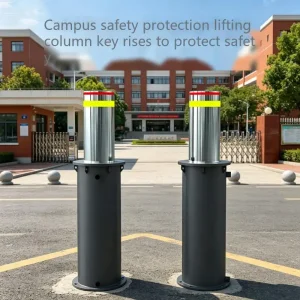
High-Efficiency Access & Perimeter Control Systems
Engineered in our ISO 9001-certified Shenzhen facility. Rigorously cycle-tested mechanisms paired with open architecture for seamless integration with third-party biometric, RFID, and ticketing controllers.
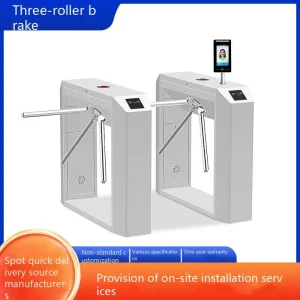



Macro Commercial Demands: The Enduring Role of Tripod Turnstiles
Why Tier-1 system integrators, EPC general contractors, and critical infrastructure managers prioritize three-arm mechanical locking architecture in modern access control.
In the evolving landscape of physical identity and access management (PIAM), the tripod turnstile remains the undisputed cornerstone for deterministic single-person passage control. While optical speed gates and high-end motorized swing turnstiles command attention in luxury corporate lobbies, high-volume industrial facilities, manufacturing perimeters, educational hubs, public transport hubs, and sports stadiums demand structural rigidity, mechanical tamper resistance, and unrelenting reliability under harsh operating conditions.
A precision-engineered tripod turnstile operates on a mechanical lock-and-index principle. It physically enforces positive separation: only one human being can pass through the rotating arm quadrant per valid authentication pulse. Optical sensors in sensor-based speed lanes can be cheated by aggressive tailgating or side-by-side forcing; a solid 304 or 316 stainless steel tripod arm, backed by a precision-machined ratchet and solenoid or brushless motor drive, prevents forced unauthorized physical breach without catastrophic mechanical destruction. For facilities managing tens of thousands of shift workers daily, mechanical reliability is not merely a preference—it is an operational mandate.
Deterministic Anti-Tailgating
The 120-degree rotating tripod mechanism physically limits passage volume. Once the rotation cycle begins, reverse motion is immediately arrested by heavy-duty hardened ratchet pawls, preventing counter-flow and following entry.
- Hardened steel mechanical ratchet mechanism
- Bi-directional electronic optical rotation verification
- Zero blind spot physical passage confinement
Brushless DC Servo Efficiency
Modern industrial turnstiles transition away from traditional mechanical solenoid spring mechanisms to closed-loop Brushless Direct Current (BLDC) servo motors, drastically cutting maintenance costs.
- Smooth arm rotation with digital braking damping
- Zero mechanical wear components in drive core
- Low standby power consumption (< 15W)
Automatic Drop-Arm Emergency Logic
Life safety compliance is paramount. Upon mains power interruption or active fire alarm dry-contact trigger, the upper horizontal arm automatically collapses downward, establishing an unobstructed egress lane.
- Emergency fire loop integration standard (NO/NC)
- Electromagnetic latch release in under 100ms
- Manual key bypass option for secure facilities
Tripod Turnstile Mechanics: Semi-Automatic vs. Fully Automatic Core
A comprehensive component breakdown detailing metallurgy, electronics, and dynamic kinematics for engineering consultants and hardware specifiers.
| Engineering Parameter | Semi-Automatic (Solenoid Drive) | Full-Automatic (Brushless DC Servo) | Industrial Heavy-Duty Variant |
|---|---|---|---|
| Actuation Principle | Manual push initiation after solenoid unlatches | Motorized power assist upon authorization pulse | High-torque planetary gearbox assist |
| Chassis Metallurgy | SUS304 Stainless Steel (1.2mm - 1.5mm) | SUS304/SUS316 Marine Grade (1.5mm - 2.0mm) | Reinforced 2.0mm SUS316 with anti-vandal coating |
| Operating Life Cycle (MCBF) | 3,000,000 Cycles | 5,000,000 - 10,000,000 Cycles | 8,000,000+ Severe Industrial Cycles |
| Arm Damping Technology | Adjustable Hydraulic Shock Absorber | Electronic Vector Counter-EMF Braking | Dual Hydraulic + Closed-Loop Servo Feedback |
| Noise Generation | < 58 dB (mechanical latch click) | < 45 dB (whisper-quiet operation) | < 52 dB (engineered industrial tolerance) |
| Drop-Arm Mechanism | Solenoid power-loss drop latch | Motorized drop & auto-reset mechanism | Fail-safe gravity drop with motorized reset |
| Operating Temperature | -20°C to +70°C | -35°C to +75°C (with internal heating element) | -40°C to +80°C (extreme environmental package) |
Kinematic Damping and Motion Stability
One of the classic vulnerabilities in inferior tripod turnstiles exported across the globe is "arm bounce-back." When an authorized pedestrian briskly pushes through a turnstile, the rotating assembly accumulates kinetic energy. In lower-tier systems using weak mechanical springs, the mechanism slams into the next locking detent, recoils, and may either falsely re-lock or trap the trailing user's clothing. High-tier industrial turnstile exporters utilize dual-stage dynamic deceleration.
In semi-automatic turnstiles, this is achieved via an adjustable automotive-grade hydraulic damper combined with a neodymium positioning cam. In brushless servo-driven tripods, dynamic vector algorithms calculate the exact rotational velocity and angle via 14-bit magnetic absolute encoders. As the arm approaches the 100-degree rotation mark, reverse magnetic electromotive force (EMF) is applied, decelerating the arm smoothly into its home position without mechanical collision. This eliminates shock vibration, reduces structural fatigue on the floor anchorage, and ensures ultra-quiet duty cycles.
Macro Industry Deployments: Tailored Architectures
Turnstile hardware engineered to address unique operational friction points across manufacturing, commercial, civil, and mission-critical infrastructures.
Manufacturing & ESD Protection
Integrated turnstiles featuring dual-shoe and wrist-strap Electrostatic Discharge (ESD) testers. The arm unlatches only when body resistance tests fall within compliant ranges.
- Real-time resistance data logging to HR ERP
- Breathalyzer alcohol testing interlocks
- Shift-change high-volume burst throughput
Stadiums & Automated Ticketing
Equipped with ultra-fast omnidirectional 1D/2D QR-code scanners, NFC/RFID readers, and high-intensity status LEDs for rapid arena crowd ingestion.
- Anti-counterfeit digital ticket validation
- Rugged exterior anti-vandal certification
- Bi-directional ingress and post-match egress
Construction & Harsh Environments
Heavy-gauge galvanized and powder-coated tripod turnstiles mounted on integrated forklift-ready steel skids or inside ISO mobile container gates.
- IP66 rated biometric face & palm readers
- Worker helmet and PPE camera verification
- Offline cache buffering during cellular outages
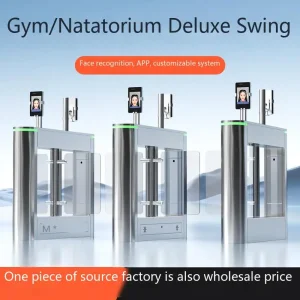
Fitness, Gyms & Leisure Hubs
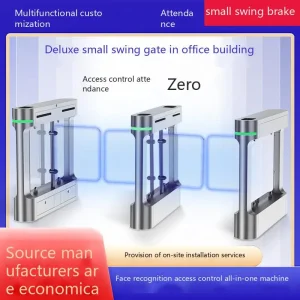
Sleek, compact footprint bridge-type turnstiles offering members touchless access via mobile Bluetooth credentials, barcode wallets, or facial identification.
- Anti-passback gym membership policing
- Integrated turnstile turn-lock lockers
- Unmanned 24/7 fitness club cloud access
Export Standards, Certifications, and Quality Assurances
Overcoming the technical and legal barriers of international deployment: electrical safety, fire regulations, electromagnetic compatibility, and transit packaging.
Purchasing access control turnstiles from Chinese factories for international deployment requires rigorous vetting against regional building codes and trade compliance requirements. As a premier original equipment manufacturer (OEM) and exporter, Anrui implements end-to-end quality controls matching strict overseas expectations across the European Union, the Americas, the Middle East, and Asia-Pacific.
CE & Electromagnetic Compatibility
Every motherboard, power unit, and motor driver complies with CE Low Voltage Directive (LVD 2014/35/EU) and EMC Directive (2014/30/EU). Turnstiles operate stably without interfering with sensitive surrounding IT infrastructure.
NFPA 101 Life Safety Code Compliance
Emergency egress compliance is strictly verified. Our fail-safe electromagnetic drop-arm modules are calibrated to drop within 100 milliseconds upon power loss, satisfying American NFPA 101 and European EN 13637 emergency regulations.
Export-Grade Shock & Ocean Packaging
Moisture and mechanical damage during maritime freight are eliminated. Units are vacuum-sealed in desiccant-loaded polyethylene shrouds and bolted inside ISPM 15 heat-treated fumigation-free wooden crates.
Frequently Asked Questions: Global Buyer Guidelines
Authoritative technical and logistical answers for systems engineers, procurement officers, and project directors.
The AIoT Revolution in Turnstile Automation
Bridging physical mechanics with Edge AI, predictive telemetry, and touchless credentials.
The turnstile of tomorrow is no longer a passive mechanical barrier; it is an intelligent edge-computing node connected to building management systems (BMS) and physical security information management (PSIM) software platforms. Anrui's R&D engineering roadmap actively deploys smart telemetry monitoring right onto the turnstile controller.
By leveraging integrated current-sensing transducers and vibration sensors, our fifth-generation controllers constantly monitor motor torque curves, friction coefficient changes, and ambient thermal variances. Before a mechanical spring experiences fatigue failure or a hydraulic damper loses viscosity, automated MQTT telemetry alerts the facility operations team via cloud dashboard, turning scheduled routine maintenance into predictive, zero-downtime servicing.
Equip Your Next Access Project With Precision Engineering
Consult with our Shenzhen technical engineering division for custom turnstile designs, comprehensive project tenders, CAD floor layouts, and competitive factory-direct export quotations.
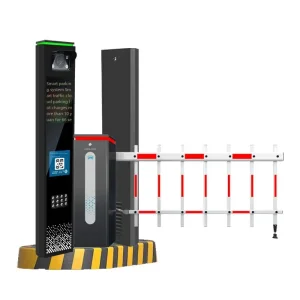
Cohesive Vehicle & Pedestrian Access Ecosystem
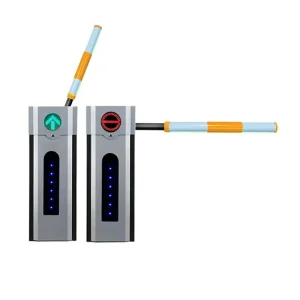
Integrate turnstiles seamlessly with our full portfolio of boom gates, license plate cameras, hydraulic bollards, and parking locks for complete perimeter management.