
Featured Fast-Deployment Smart Vehicle & Pedestrian Systems
Precision-engineered access barriers and perimeter security hardware tested across 5,000,000 continuous operation duty cycles.
Global Industry Trends: From Mechanical Actuators to Intelligent Edge Nodes
Analyzing the shift toward low-inertia permanent magnet synchronous drive trains, remote telemetry, and zero-downtime parking architectures.
Transition to Brushless DC (BLDC) & Servo Technology
Traditional AC torque induction motors rely on friction clutch plates, high mechanical gearing reduction, and external limit micro-switches that degrade under intense thermal expansion. Today’s industrial smart car parks demand integrated 24V/36V BLDC or digital servo drive assemblies.
- Elimination of carbon brush wear and periodic oil replenishment.
- Direct digital hall sensor angle feedback guaranteeing smooth decel curves.
- Up to 75% reduction in overall operating heat dissipation under 100% duty cycle.
Edge-AI Computing & Integrated ANPR Protocols
Modern parking barriers are no longer passive barriers; they act as primary hardware execution nodes within cloud-managed Intelligent Transportation Systems (ITS). Seamless edge processing drives instant lane clearance and automated license plate verification.
- Trigger-less vehicle verification via 79GHz high-frequency radar sensors.
- Sub-0.6 second high-speed opening profiles preventing entry bottlenecks.
- Direct Ethernet/MQTT telemetry reporting real-time cycle metrics and torque abnormalities.
Mean Time Between Failures (MTBF) Benchmark Shift
Municipal infrastructure tenders, airport terminal concessions, and logistics hubs specify strict MTBF thresholds. Enterprise procurements have elevated expected operational lifespans from 1.5 million cycles to over 5 to 10 million non-stop strokes.
- Standardized modular components allowing Field Replaceable Unit (FRU) swaps.
- Tool-less spring tension adjustment mechanisms minimizing site service time.
- Universal left/right arm orientation switching without gearbox disassembly.
The Core Engineering Axiom: "Easy-maintainable" does not mean frequent easy repairs. It denotes an architecture built on prevention-first principles: brushless commutation, frictionless magnetic sensors, impact-decoupling boom brackets, and self-calibrating spring balances that reduce overall on-site maintenance frequency by over 80%.
Engineering Breakdown: Inside an Easy-Maintainable Barrier Gate
Examining the structural mechanics, electrical architecture, and modular sub-assemblies that minimize field technician intervention.
1. Planetary Integrated Gear & BLDC Core
Traditional worm-gear transmissions generate severe sliding friction, resulting in backlash, metal shavings, and mechanical jamming over time. Our barriers integrate high-precision planetary gearboxes hardened to HRC 58-62.
Coupled with 24V/36V brushless DC motors, this transmission offers pure rolling contact, virtually zero mechanical backlash, and permanent synthetic grease lubrication that eliminates periodic oil refilling throughout the machine's 10-year lifecycle.
2. Plug-and-Play Control Logic Boards
Site technicians often face complex wiring harnesses when replacing motherboards. Our barrier architecture isolates power conversion, digital motor drive, and auxiliary I/O into clear modular blocks.
Featuring quick-disconnect industrial terminals, digital OLED parameter displays, and self-teaching travel limits, replacing an entire logic motherboard requires less than 8 minutes without soldering or external programming tools.
3. Impact Decoupling & Swing-Away Boom Arms
Vehicle impact is the leading cause of car park barrier damage globally. Rigid boom mounts transfer destructive kinetic energy straight into the output shaft, cracking gear teeth and bending main chassis mounts.
Our easy-maintainable systems incorporate a patented 90°/180° swing-away breakaway bracket. Upon impact, the boom unlatches cleanly without destroying internal gears. Technicians simply snap the arm back into locking alignment in seconds.
4. Dynamic Dual-Spring Balance Calibration
Fatigued counterbalance springs create heavy motor drag, causing motor burnout and erratic movement. Our dual-spring compression/tension architecture distributes kinetic loads evenly across reciprocal axes.
Tuning spring tension for different arm lengths (from 3-meter high-speed highway booms to 6-meter commercial fence arms) requires adjusting an ergonomic, calibrated exterior locknut rather than tedious internal disassembly.
China Factory 4.0: Supply Chain Resilience, Precision Robotics & Cost Efficiency
How Shenzhen Anrui leverages end-to-end BOM vertical integration, robotic laser processing, and automated quality testing to deliver world-class access equipment.
100% Vertical BOM Integration
Unlike regional assemblers reliant on multi-tiered third-party sourcing, Anrui manufactures critical components in-house inside our 8,000 m² facility in Guangming, Shenzhen. From heavy-gauge cold-rolled carbon steel sheet stamping (2.0mm enclosure wall thickness) to SMT circuit board surface mounting, vertical control prevents supply chain bottlenecks and guarantees consistent batch-to-batch metallurgical integrity.
Automated Robotic Surface Treatment
Chassis longevity determines maintenance overhead in coastal or desert environments. Our enclosures undergo automated 7-stage phosphating pickling, followed by electro-deposited epoxy primer and outdoor-grade AkzoNobel electrostatic fluorocarbon powder baking. The resulting 120μm protective coating withstands 1,000+ hours of continuous neutral salt spray (ASTM B117), impervious to UV degradation and extreme corrosion.
72-Hour Full-Load Continuous Burn-In
Every single barrier drive core and logic motherboard is subject to automated environmental stress testing before shipping. Barriers undergo 72 hours of uninterrupted reciprocal actuation under simulated inertia loads across -30°C to +75°C temperature swings. This empirical process eliminates early electronic component infant mortality, ensuring zero-defect installation upon arrival at your overseas project site.
Engineering Spec Comparison: Selecting the Optimal Barrier Topology
Comprehensive performance benchmarks comparing brushless DC architectures against obsolete mechanical transmission types.
| Technical Parameter | Anrui Easy-Maintainable BLDC Series | Conventional AC Torque Motor Gate | Hydraulic Heavy-Duty Actuator |
|---|---|---|---|
| Motor Drive Core | Brushless DC (24V/36V) / Permanent Magnet Servo | Single-Phase AC Induction Torque Motor | Hydraulic Pump & Double-Acting Piston |
| Operating Duty Cycle | 100% Continuous Duty (No thermal cut-off) | 40% - 60% (Prone to thermal tripping at peaks) | 80% - 100% (High continuous torque) |
| Opening / Closing Speed | 0.6s to 6.0s (Digitally adjustable by software) | Fixed speed (Usually 3.0s or 6.0s mechanical) | 2.0s to 5.0s (Adjustable via hydraulic valves) |
| MCBF Reliability | 5,000,000 to 10,000,000 Cycles | 1,000,000 to 1,500,000 Cycles | 3,000,000 to 5,000,000 Cycles |
| Lubrication & Service Needs | Zero Maintenance (Sealed planetary gear unit) | Frequent gearbox grease & clutch check | Periodic hydraulic oil changes, seal replacements |
| Power Consumption | 60W – 150W Dynamic (Ultra-low standby: 5W) | 250W – 450W Continuous draw | 350W – 750W Continuous power draw |
| Manual Operation in Blackout | Ergonomic manual handwheel / Battery backup ready | Requires physical hand-cranking key tool | Manual bypass hydraulic release valve |
| Anti-Smash Protection | Built-in electronic torque sensing + Radar/Loop interface | External loop detector & pressure wave only | Pressure release valve + external optical sensors |
Localized Application Scenarios: Tailored Access Solutions
From high-speed highway toll stations to underground corporate garages with restricted ceiling clearance.
Underground Multi-Level Garages (Folding Arms)
Low structural ceiling heights (2.2m to 2.8m) prohibit full-height straight boom elevation. Our 90-degree and 180-degree articulated folding boom barriers feature internal linkage rods engineered from aircraft-grade aluminum alloy.
Smooth articulating motion prevents collision with low-hanging sprinkler pipes, ductwork, and lighting conduits, while maintaining lightning-fast 1.2-second vehicle clearance.
High-Throughput Highway Toll & Logistics Hubs
Distribution centers and toll plazas experience brutal around-the-clock traffic of over 15,000 daily cycles. Equipment failures instantly back up arterial freight corridors.
Anrui high-speed 0.6-second toll barriers use carbon-fiber composite rounded booms with low wind resistance, digital brake algorithms that eliminate terminal bounce, and self-recovering collision clutches.
Commercial Plazas & Revenue-Generating Entrances
Why let prime entrance real estate sit idle? Our intelligent advertising barrier gates combine heavy-duty access management with automated illuminated billboard panels.
Louvered wind-release mechanisms allow safe operation even in gale conditions (up to Force 8), creating an attractive secondary recurring ad revenue stream for commercial property owners and operators.
Extreme Climates: Desert Heat to Sub-Zero Cold
Deployments in the Middle East experience +55°C ambient air with intense airborne sand, while Scandinavian sites face -30°C freezing conditions. Standard barriers lock up due to grease congealing or electronics overheating.
Our units incorporate wide-temperature aerospace lubricants, IP65 hermetically sealed drive enclosures, and intelligent built-in PTC thermostatic heater/fan modules that regulate internal chassis conditions automatically.
Explore Complete Parking & Integrated Security Systems
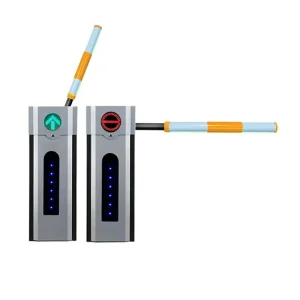
Select from precision articulated barriers, intelligent LPR cameras, and anti-ram rising bollards direct from our Shenzhen manufacturing lines.


Frequently Asked Questions: Technical Due Diligence
Detailed answers compiled by our chief hardware engineers for system integrators, EPC contractors, and facilities directors.