
Why Choose an Electric Boom Gate for Global Buyers?
Global buyers are rethinking how vehicles enter offices, warehouses, airports, and residential communities. An Electric Boom Gate offers controlled movement without demanding a full-time guard at every lane. Its 24-volt motor can lift a three-to-six-metre arm, while RFID readers, loop detectors, or license-plate cameras support practical access decisions. The result is visible and measurable: a raised barrier, a recorded entry, and fewer uncertain moments at the driveway.
Industry figures support this direction. MarketsandMarkets’ Automated Gates Market report projects growth from about USD 2.1 billion in 2023 to USD 3.0 billion by 2028. Fortune Business Insights also reports continuing expansion in the broader access-control market, driven by connected security and automation. Security analyst Blake Kozak has said, “The access control market is moving toward more integrated and intelligent solutions.” His observation fits modern boom-gate projects, where hardware, software, safety sensors, and maintenance must work together.
Still, forecasts do not guarantee performance. A coastal site may corrode faster. A dusty logistics yard may obstruct sensors. A busy five-metre lane may expose weak motors within months. Global buyers should examine duty cycles, wind resistance, emergency release, spare-part access, and regional service support. Certification matters too, although labels alone cannot replace engineering judgment. An Electric Boom Gate is not automatically the best choice. It becomes valuable when its speed, safety controls, climate protection, and traffic capacity match the actual site. That part is often underestimated. The gate is simple to see, but complex to trust.
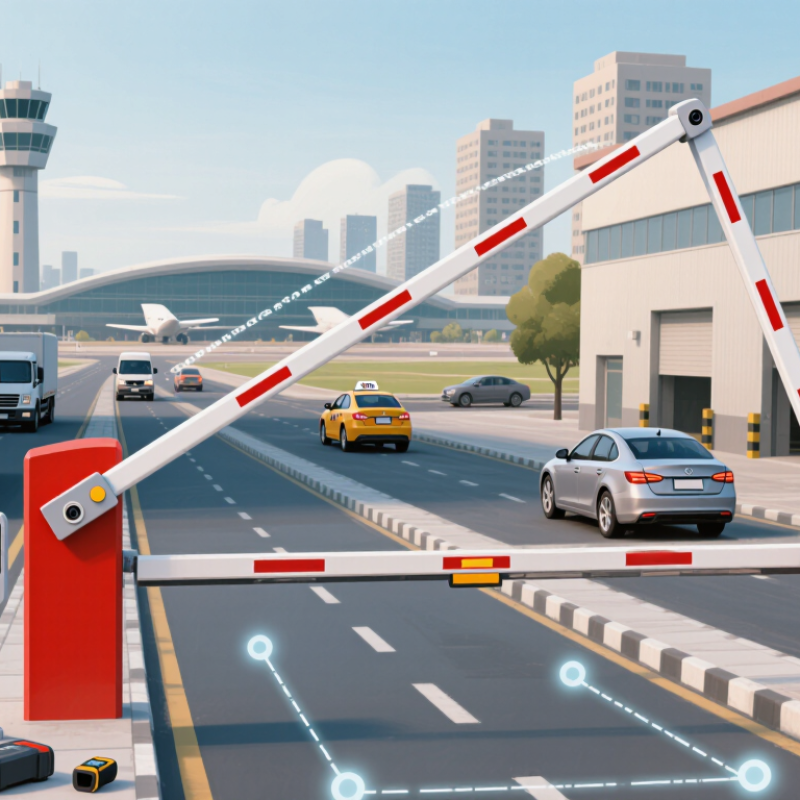
Define Electric Boom Gates: 3–6 m Arms and 1.5–6 s Opening Times
Why Choose an Electric Boom Gate for Global Buyers?
An electric boom gate controls vehicle entry with a powered arm, a motor, and safety sensors. Common arm lengths range from 3 to 6 meters, covering private lanes, warehouses, and multi-lane entrances. Opening times usually range from 1.5 to 6 seconds. That difference matters when a busy site handles repeated arrivals. A 1.5-second cycle feels efficient at a logistics entrance. A slower six-second cycle may suit a smaller residential driveway.
The International Energy Agency reported more than 14 million electric cars sold worldwide in 2023. More electric vehicles now enter offices, factories, and charging facilities. Their quieter operation makes gate movement and warning signals more important. Buyers should check motor duty cycles, weather protection, emergency release, and loop-detector compatibility. ISO 13849-1 also offers a useful framework for evaluating safety-related control functions. Specifications alone are not enough.
Speed can mislead.
A long 6-meter arm may need stronger balancing and more careful installation. A short 3-meter arm may open quickly but leave wider vehicles exposed at awkward angles. Field experience shows that poor sensor positioning causes more frustration than a slower motor. The 2024 IEA Global EV Outlook also notes continuing growth in charging infrastructure, increasing demand for dependable access control. Still, I would question any promise of universal six-second performance. Vehicle flow, temperature, wind, and maintenance change the result. Global buyers should compare tested cycle data with their actual lane width and traffic pattern.
Why Choose an Electric Boom Gate for Global Buyers? - Define Electric Boom Gates: 3–6 m Arms and 1.5–6 s Opening Times
| Data Dimension | Typical Specification or Range | Value for Global Buyers |
|---|---|---|
| Product Type | Automatic electric barrier gate for controlled vehicle access | Provides repeatable vehicle control at entrances, exits, parking areas, and restricted-access sites. |
| Boom Arm Length | Approximately 3–6 m, selected according to the lane width and installation layout | Covers common single-lane vehicle entrances without requiring a full-width gate structure. |
| Opening Time | Approximately 1.5–6 s, depending on arm length, motor configuration, and control settings | Allows buyers to balance traffic throughput, safety, and mechanical load for different sites. |
| Closing Time | Usually configurable within a similar operating range to the opening cycle | Supports controlled lane recovery after a vehicle passes while allowing safety settings to be adjusted. |
| Traffic Throughput | Dependent on opening time, vehicle spacing, access-control response, and safety clearance | Helps buyers select a suitable configuration for residential, commercial, industrial, or parking applications. |
| Power Supply | Commonly available in 100–240 V AC, 50/60 Hz configurations; local electrical requirements must be confirmed | Supports deployment across regions with different mains-voltage and frequency standards when the correct configuration is selected. |
| Control Methods | Push button, remote transmitter, keypad, RFID card reader, ticketing system, or access-control software | Makes the gate adaptable to different security procedures and existing site-control systems. |
| Safety Equipment | Photocells, vehicle loops, radar sensors, warning lights, and optional boom-arm safety edges | Reduces the risk of the arm closing on vehicles or pedestrians when correctly installed and adjusted. |
| Outdoor Protection | Outdoor enclosures are commonly specified at IP54 or higher; the exact rating varies by model | Helps buyers match the equipment to rain, dust, and site-environment requirements. |
| Emergency Operation | Manual release is commonly provided for power failures or maintenance access | Maintains access flexibility when electrical power or the control system is unavailable. |
| Visibility Features | Reflective strips, high-visibility arm markings, and optional red or green warning lights | Improves recognition of the barrier in low-light conditions and helps communicate gate status. |
| Typical Applications | Parking facilities, residential communities, logistics yards, factories, offices, toll-related access points, and private roads | Provides a scalable access solution for low-, medium-, and higher-volume vehicle entrances. |
| Selection Priorities | Lane width, traffic frequency, required cycle time, local voltage, weather exposure, safety devices, and integration needs | Enables buyers to compare equipment based on actual site conditions rather than arm length or speed alone. |
Note: The specifications above represent commonly used selection ranges and configurations. Actual performance depends on the gate model, arm length, installation quality, traffic conditions, safety settings, and applicable local standards.
FAQS
It controls vehicle entry with a powered arm, motor, and safety sensors. Arm lengths commonly range from 3 to 6 meters. It suits driveways, warehouses, offices, and charging areas.
Typical opening times range from 1.5 to 6 seconds.
Match the arm to the lane width and vehicle path. A 6-meter arm covers wider entrances but needs stronger balancing. A 3-meter arm may move faster but leave awkward side gaps. Measure the lane carefully.
Use obstruction sensing, reversing protection, photoelectric sensors, and induction loops. Warning lights should remain clearly visible. The arm must stop when a vehicle, person, or object enters its path. Sensor placement matters greatly.
No. Documents should cover the complete operator and installation. Request test reports, wiring diagrams, maintenance instructions, and local conformity evidence. Inspect stopping distance and sensor alignment on site. Paper compliance can mislead.
Some models accept 100–240 V input. Installers must still verify frequency, grounding, surge protection, and local wiring rules. Check the cabinet label, not only the brochure. A wide voltage range is helpful, not complete.
Check the stated temperature, humidity, and enclosure protection. An outdoor enclosure should resist dust and water exposure. It is not waterproof. Coastal sites need corrosion protection for hinges, terminals, and fasteners. Cold areas may require suitable lubricant and battery checks.
Inspect sensors, hinges, terminals, cable glands, and emergency release parts. Clean dusty surfaces and check drainage around the cabinet. Test power-failure access regularly. Small faults matter. I once focused too much on voltage compatibility. That was too narrow.
Conclusion
An Electric Boom Gate is a practical access-control solution for international buyers seeking reliable vehicle management at commercial, industrial, residential, and public sites. With boom arms typically ranging from 3 to 6 meters and opening speeds of approximately 1.5 to 6 seconds, it can be selected according to traffic flow and entrance layout. Buyers should also review safety compliance, including relevant UL 325, EN 12453, and IEC 60335 requirements, to support dependable and responsible operation.
For demanding environments, evaluate 24/7 duty-cycle capability, IP54 to IP65 protection, motor performance, and resistance to heat, cold, dust, and moisture. A wide 100–240 V input range can simplify installation across different regions. Remote control functions may improve convenience and reduce staffing and labor costs, while durable construction and accessible servicing can extend the equipment’s useful life. Considering installation, safety, performance, maintenance, and long-term operating value helps global buyers choose a suitable gate system with greater confidence.
